Eachlabs for AI Model Orchestration and Routing in 2026
The hard part is not picking one model Ask a media team what's slowing them down and you'll rarely hear "we can't find a good model." They've found five. What they can't do is get those five to behave like one system. Consider a single product request: generate a base image, run image-to-image edits against brand rules, drive a short clip from a reference video, extend it with text-to-video, then lay down native synchronized audio that actually matches the cut. Five steps. Five different model
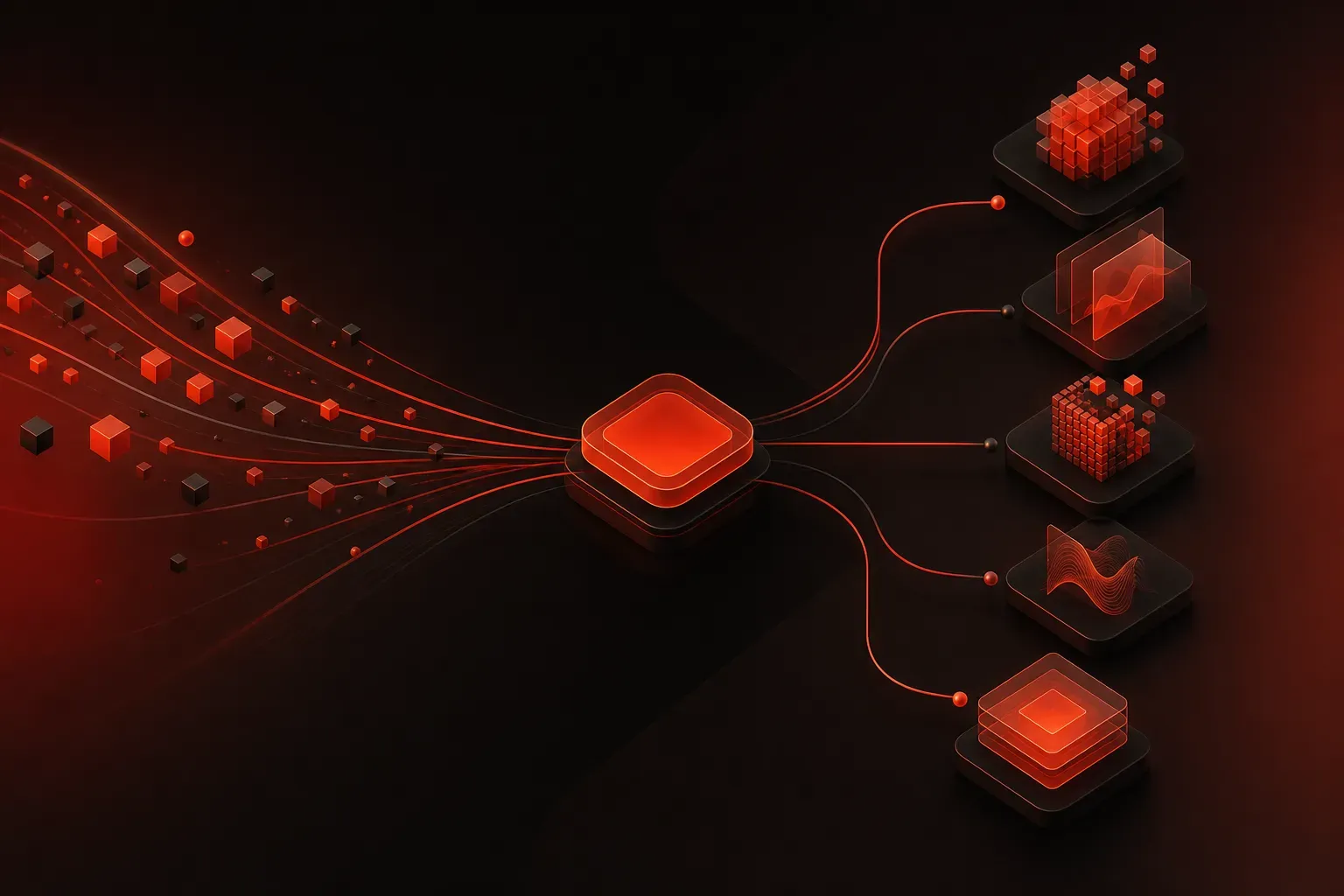
The hard part is not picking one model
Ask a media team what's slowing them down and you'll rarely hear "we can't find a good model." They've found five. What they can't do is get those five to behave like one system.
Consider a single product request: generate a base image, run image-to-image edits against brand rules, drive a short clip from a reference video, extend it with text-to-video, then lay down native synchronized audio that actually matches the cut. Five steps. Five different model families. Five chances for an artifact to go missing, a format to drift, or a retry to silently produce something nobody approved.
Eachlabs is a developer-first AI workflow platform that gives backend teams unified access to image, video, audio, and text generation models through one interface, so that chain runs as a workflow instead of a pile of scripts. Not a notebook. Not a dashboard someone babysits. Repeatable backend workflows, in the same sense the ML workflow platform guide describes — versioned runs, artifact handoff between steps, controls that survive production traffic.
So the useful questions aren't about rankings. They're operational. How do you route each step to the model that suits it? How do you chain steps so state and artifacts survive? And what has to be true before that pipeline is safe to leave running?

How model routing should work when speed, cost, and quality all matter
Picking "the best model" is the wrong question, and it stays wrong for about a week — until the next release resets the leaderboard. The question that survives is narrower: for this step, in this chain, under this latency budget, which model is good enough and what happens when it isn't?
That's routing. Not a model preference, but a policy layer sitting between your request and the model catalog. A useful policy reads the task type first (text, image generation, image-to-image, text-to-video, reference video, native synchronized audio), then the constraints attached to it — how long the caller can wait, what quality floor the output has to clear, whether the step is user-facing or a background job — and then picks the cheapest capable model that clears the bar, escalating to a stronger one only when the task demands it. Best capable for the high-stakes step. Cheapest capable everywhere else.
Production data backs the split. Vercel's AI Gateway production index, published in May 2026 from seven months of gateway traffic, reports that spend and token volume rank providers differently: Anthropic took 61% of April spend while Google carried 38% of April token volume. Premium reasoning calls and cheap high-throughput calls simply aren't competing for the same request. The same report notes high-volume workloads route across 30 or more distinct models on average. Teams already run mixed fleets, whether or not they've written the policy down.
Media workflows push this harder than text-only systems do. A single product-video chain might need one model to generate a base image, another to run image-to-image cleanup with a locked reference, a third for motion control, and a fourth for audio that lands in sync. Those steps don't share an output format, a latency profile, or a failure mode. Routing them through one general-purpose engine means accepting the worst tradeoff at every step.
Fallback is where the policy earns its keep. A model can fail loudly — a timeout, a rate limit, an error code — and that's the easy case. The harder case is a call that returns 200 with an unusable artifact: a black frame, a drifted face, audio a few hundred milliseconds off. Production routing needs a validation gate after generation, not just retry-on-error, and a defined second choice for each step so the chain degrades instead of dying.
Treated this way, an AI workflow platform isn't crowning a winner. It's a scheduler with taste, matching each step to a model that can do that step, and keeping the artifacts intact when the first choice doesn't hold up.
Workflow orchestration is where media systems stop being demos
The demo always works. One prompt, one model, one clean output, and everyone in the room nods. Then someone asks what happens when the render comes back with the wrong aspect ratio at three in the morning, and the whole thing falls apart — because a demo is a call, and production is a chain.
A real media pipeline is a sequence, not a prompt. You generate a base asset. You transform it — an image-to-image pass to correct style drift, a crop, an upscale. You validate it against something checkable: dimensions, duration, a moderation pass, a similarity score against the reference. You store it with the run that made it. Then you hand the artifact forward, because the next step needs it. Text-to-video takes the corrected still. A reference video constrains motion so the subject doesn't melt between frames. Native synchronized audio lands on the cut rather than being bolted on afterward in an editor nobody wants to open. Each of those steps has different failure modes, different latency, and often a different model behind it.
Which is why state matters more than model choice. If step four can't see the prompt, seed, and metadata from step one, you end up writing glue code to carry them — and that glue is where pipelines rot. Prompts get retyped slightly differently. An asset gets regenerated instead of reused. A run becomes unreproducible, so when output quality shifts you can't tell whether the model changed or your pipeline did. Persisting prompts, assets, and run metadata across the whole chain isn't a convenience feature. It's the difference between a workflow you can debug and one you can only rerun and hope.
Then there's branching. Generative steps fail in ways deterministic code doesn't: not with an exception, but with something that returns 200 and looks wrong. So the flow needs conditional paths — retry with a different seed, route to an alternate model when the first one times out or produces an unusable frame, trigger a corrective edit when a validation check fails instead of dumping the whole run. Published production traffic data from a large model gateway reported in 2026 found that high-volume workloads route across more than thirty models on average. That number isn't about variety for its own sake. It's what routing looks like once real traffic hits real constraints.
Most orchestration tooling stops at text. It handles model selection, fallback, and observability for token workloads, then leaves media as an exercise for the reader. Eachlabs's own guide to AI workflow platforms for ML teams frames the same shift for ML work generally: versioned runs, artifact handoff, and production controls instead of notebook-first experimentation.
Chaining prompts is a weekend project. Orchestration is what you build when the output has to be right every time, and someone downstream is depending on it.
Security and enterprise readiness are part of the workflow, not an afterthought
The demo works. Then someone in legal asks where the generated video is stored, who can rerun the job, and whether the reference image a customer uploaded is going to end up in a training set. That's usually where a media pipeline stalls — not on quality, on questions nobody wrote down at the start.
So write them down. Before any generation step touches real customer inputs, get answers on three things: whether your data is excluded from model training by default, whether content is encrypted at rest and in transit, and which attestations actually exist on paper. The frameworks worth naming explicitly are SOC 2 Type 2, ISO 27001 and its 27017/27018/27701 extensions, ISO 42001 for AI management systems, plus GDPR, CCPA, HIPAA, FERPA and PCI-DSS where your sector demands them. Large model providers publish these lists publicly, which means you can hold every layer of your stack to the same standard. Ask for retention windows on generated artifacts too. Media files persist in ways a text completion doesn't.
Access control gets harder the moment one workflow layer fans out across image, video, and audio models. A credential that can call an image generation API can usually call the video and audio ones as well, and a workflow that stitches five steps together inherits the widest permission in the chain. Scope keys per environment, keep staging out of production buckets, and log who triggered which run with which inputs. When an artifact leaks, the run ID is the only thing that tells you how it happened.
Reliability deserves the same discipline. Video and audio steps run in minutes, not milliseconds, so per-step timeouts, idempotent retries, and failure isolation matter more than they do in a text-only chain — a failed synchronized audio step shouldn't throw away an expensive upstream render. Eachlabs describes this as part of what an AI workflow platform should provide, listing versioned runs, artifact handoff, model routing, and production controls as baseline expectations rather than add-ons.
The honest tradeoff: all of this adds setup work, and scoped credentials plus per-step observability will slow your first launch by days. Skip it, and you find out what broke from a customer instead of a dashboard.

What buyers ask about agent frameworks, gateways, and multi-model APIs
Is an agent framework the same thing as a workflow platform?
- Agent frameworks are built for planning: the model picks tools, decides the next step, and improvises when the path isn't known in advance. That's genuinely useful for open-ended tasks. A media pipeline is usually the opposite problem. Generate, edit, validate, assemble, deliver — the order is known, and runtime improvisation is a defect rather than a feature. If you can draw the graph on paper, you want deterministic execution with versioned runs, not a planner rediscovering it on every call.
If I already have a gateway, do I need orchestration on top?
Gateways handle one layer well: a single endpoint across many models, fallback when a provider degrades, policy, and traffic visibility. That layer isn't cosmetic. A seven-month index of production gateway traffic reports that high-volume workloads route across more than 30 models on average, and that the model families leading spend and leading request volume weren't the same. Routing breadth is a real production pattern. But a gateway forwards requests. It doesn't hold the intermediate frame, the mask, the reference clip, or the audio track that step four depends on.
How does a multi-model API compare once editing and handoff are involved?
Access breadth solves discovery, not state. The moment one step consumes another's output — image-to-image applied to a generated frame, a reference video driving motion control, native synchronized audio aligned to a cut — you need artifact storage, run history, and retries that resume instead of restarting the chain. That gap is where teams end up writing a queue, a blob store, and a retry layer by hand. An AI workflow platform exists to absorb that work, which is roughly the argument laid out in the Eachlabs guide to moving ML teams from notebooks to repeatable backend workflows.
When is a text-focused router actually the better pick?
When the traffic is text. If you're serving chat, extraction, summarization, or classification at scale, a router purpose-built for token traffic will usually give you tighter streaming ergonomics, finer token accounting, and less overhead per hop than anything designed around media artifacts. Don't adopt a media-oriented stack for a text-only product.
What fits a mixed image, video, and audio pipeline?
Something that treats the chain as the unit of work. Eachlabs is built around generative media models with orchestration, model routing, and artifact handoff in one backend path, which matters most when a single job crosses image, video, and audio. Text-heavy workloads still deserve a separate look.
If you're building that kind of pipeline, Eachlabs is the place to start.