AI Music Generation APIs: The License Is the Product
In AI music generation APIs the license is the product: what commercial use really requires.
Every AI music generation API sounds good in the demo. That's what a demo is for.
You type a mood, you get a track, the track holds up. Better than holds up, sometimes. Then you try to put it inside a product and the interesting problems start. Not "does this sound good." More like: am I allowed to ship this? What happens when a player triggers it at runtime and the network is busy? Who owns the file eighteen months from now, when the contract comes up for renewal and there are ten thousand generated cues sitting inside a build you already shipped?
Eachlabs enters this category from an unusual angle, as a workflow layer rather than an engine, with text-to-song models sitting in the same garden as image and video models and callable from Node.js, Python, Golang, or plain HTTP. That framing matters, though not for the reason most comparison posts give.

The Demo Is Not the Hard Part
A music generation API is not a box that plays a clip in a browser tab. Inside a product it's a service. It takes a prompt or a set of parameters (genre, mood, BPM, duration) and hands back an audio asset your backend then has to store, trim, loop, and serve.
Games expose this fastest. A soundtrack gets requested at runtime, cached, swapped as the scene or the player state moves. And adaptive scoring almost never means what people assume it means. You aren't streaming gameplay events into a model and receiving reactive music back in real time. You're generating short stems and variations ahead of time, then crossfading between them locally, because no network is going to keep pace with a boss fight.
Which sets up the question underneath every evaluation in this category: are you buying a sound, or are you buying the right to ship it? Two different purchases. Only one of them shows up in the demo.
Read the License Like It's the Product
Every provider here markets the same promise in slightly different words. Royalty-free. DMCA-free. Copyright-safe. Cleared for commercial use, whether the vendor leads with stem extraction, section-level editing, streaming output, or a curated library underneath the generation.
Marketing language and contract language are not the same artifact.
So before you ship, get written answers to a specific set of questions. The specificity is the entire point. Do the rights cover tracks your end users generate, or only tracks you generate? Is distribution capped by plays, by seats, by platform count? Do sync rights extend to monetized video, or stop at the app boundary? Is attribution required, and required where exactly? And the one that catches teams late: what happens to audio already embedded in shipped builds if you cancel?
Ask for the terms document. A landing page is not a terms document.
That gap is where projects actually stall. A working preview proves the model can do the thing; a signed license is what lets a studio keep that audio in front of paying users. One takes an afternoon. The other takes legal.
Routing changes none of it. Eachlabs can pass a request through a music generation API and hand the resulting audio to downstream steps in the same backend workflow, but the rights attached to that file come from the model you selected. A platform layer standardizes the call. It does not standardize the license, and any vendor implying otherwise is selling you something.

Build for the Wait
Generating a track is one step in a longer chain, almost never the product itself. The flow that works looks roughly the same everywhere.
Your backend assembles a cue. Sometimes that's a literal prompt from a user, more often it's something structured: a scene's mood tag, a biome, a combat state, a video timeline's duration and pacing. That cue goes to a prediction endpoint with the model and version attached. Eachlabs's guide to building AI song applications shows the shape of it: a POST to api.eachlabs.ai/v1/prediction carrying model, version, and an input object, authenticated with an API key header.
Then you wait. This is the part teams design around too late. Typical median runtimes in this category sit around one to two minutes, not milliseconds, so treat the response as a job handle and nothing more. Persist the prediction ID. Poll it, or consume a callback. Keep the user-facing request non-blocking, because a player stuck watching a loading screen while a level's music comes back over the wire is a bug you will ship and then have to unship.
When the audio lands, write it to storage you control. Keep the prompt, the model, the version, and the duration as metadata next to it. Dull work, right up until the afternoon you need to regenerate a cue, answer a licensing question, or explain why one track sounds different from the forty around it.
Retries on transient failures, timeouts on long jobs, and a fallback path to a second model all belong in the workflow layer. Not in your game loop. Not in your render pipeline. That's a design rule rather than a preference.
Two shapes worth stealing. In a game, a level-load handler sends scene metadata to the generation step, caches the returned stems per zone, and crossfades locally. In a video tool, the audio job runs in parallel with rendering and the two artifacts meet at the mux stage.
The Models You'd Actually Be Routing To
"Route to whichever model fits" is easy to say and meaningless until you name the models. So here are three currently in the Eachlabs garden, and what separates them in practice.
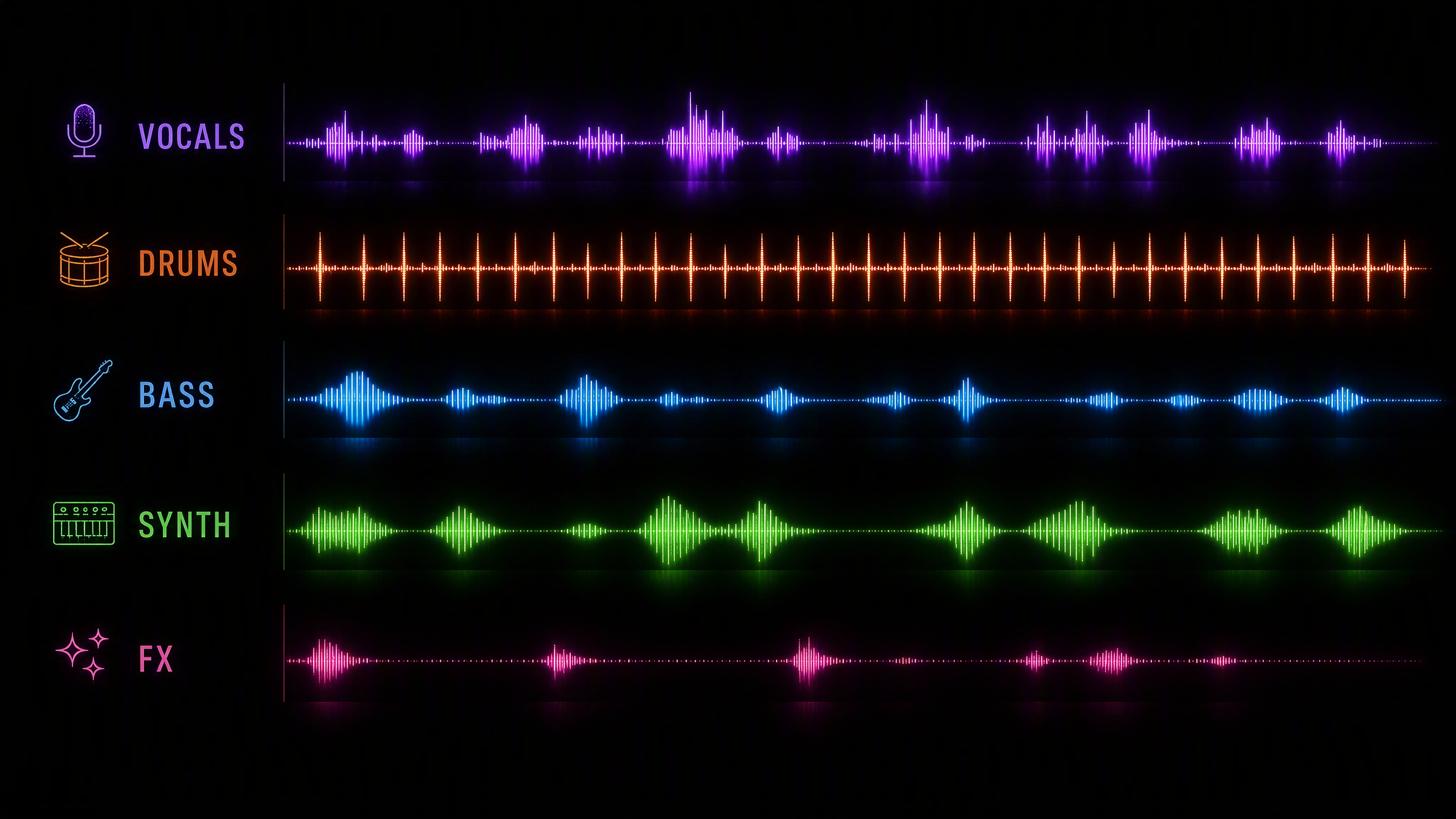
Mureka Generate Song builds complete tracks from prompts, lyrics, or reference audio, and it plans before it synthesises. Its MusiCoT approach reasons through time signature, BPM, and section layout (intro, verse, chorus) ahead of generating audio, which is why the output holds together across a full three or four minutes instead of drifting. It exports separated stems for vocals, drums, bass, and synths, handles vocals in ten-plus languages, and returns MP3, WAV, and FLAC. The quietly useful part is buried in the response: it returns lyric sections with per-word timing. If you're building captions, karaoke, or lip-sync, that's a feature you'd otherwise be writing a forced-alignment pipeline for.
MiniMax Music 2.5 takes lyrics plus a style prompt and returns a produced track with vocals and instrumentation. What matters for a shipping product is that audio settings are request parameters rather than post-processing chores. Sample rate, bitrate, and format go in the audio_settings object, so you ask for 44.1 kHz MP3 at 256 kbps and that's what arrives. Median runtime sits around two minutes, which is exactly the kind of number that should be shaping your job queue rather than surprising it.
MiniMax Music v2 has the longest ceiling of the three at up to five minutes, with paragraph-level structure control through [verse], [pre-chorus], and [chorus] tags in the lyrics prompt, vocals across a wide language range, and separation between vocal and accompaniment layers. Useful when you want one long continuous piece rather than short cues you'll stitch yourself.
Three different shapes of the same job. One request pattern across all of them.
Using an AI Music Generation API on Eachlabs
Eachlabs describes a workflow engine over a model garden of more than 150 models, with text-to-song models triggered through the same prediction endpoint you'd use for a video or an image model, and SDKs for Node.js, Python, Golang, and raw HTTP. Which makes the audio step a node in a graph. Moving from MiniMax Music v2 to Mureka Generate Song because you suddenly need stems is a change to the node. Not a client rewrite, not a new auth flow, not a second set of docs. The request pattern that generates a track is the request pattern that generates the thumbnail next to it.
That's the whole argument. Narrow, and it only pays off if your product actually has more than one generative step in it.

Getting Better Results Out of a Music Generation API
Generate short, loop long
Long single tracks are the wrong unit for anything interactive. Ask for thirty to sixty seconds of usable material with a clean loop point, then build length in your player. Short generations come back faster, fail less often, and hurt less to throw away when one lands wrong.
Tag the structure, don't just describe the vibe
"Epic" and "chill" aren't instructions. All three models above read structural tags in the lyrics field, so give them [verse], [pre-chorus], [chorus] and let the model plan against that skeleton. Then put genre, tempo, instrumentation, energy arc, and an explicit note of what the track should not do in the style prompt. Name the drum kit. Say whether you want a build or a plateau.
Pin the version to the asset
Store the model version alongside every generated file. Models get updated, and an updated model is a different instrument. Without that version recorded, you can't reproduce a cue you shipped eight months ago, which is a genuinely miserable way to spend a Tuesday.
Wrapping Up
The audio is the easy part now. Serious music models produce tracks that hold up inside a real product, and the distance between the good ones shrinks every quarter.
What doesn't shrink is the operational surface. Whether you're allowed to ship what you generated. Whether your backend handles a two-minute job without embarrassing itself. Whether replacing an engine takes a sprint or a coffee break. Choose on those.
Then do the thing almost nobody does before signing: run one real workflow end to end. Cue in, licensed file landing in storage you control, served to an actual client. You can build exactly that on Eachlabs, with one prediction pattern across audio, image, and video models.

Frequently Asked Questions
What should I check before signing up for an AI music generation API?
Start with the unglamorous operational questions, because those are the ones that break builds. Auth method. Documented rate limits. How long-running jobs are handled: do you poll a prediction ID, receive a webhook, or stream partial audio? Then read the quota unit very carefully, because songs, seconds, and requests are not interchangeable and teams routinely discover this after wiring everything up.
How do I verify commercial rights for AI-generated music?
Assume "royalty-free" means nothing until a contract defines it. Check whether the license covers distribution inside an app or a game, monetized video, and client work. Check whether attribution is required, whether rights survive cancellation, and who indemnifies you if a claim shows up. Get it in writing from the provider whose model actually generated the audio, because when you call a model through any aggregation layer, that provider's license still governs the output.
When is a workflow platform better than calling a music model directly?
One model, one output, direct call. Every time. An orchestration layer earns its place when the request has to chain (generate lyrics, produce the track, add narration, render a video) or when you expect the underlying engine to change. The tradeoff is an extra hop between your backend and the model, which is a fair price for not rewriting your integration twice a year.