Why AI Model Routing Breaks in Multi-Step Media Pipelines
One product request. Five model calls. Generate a base image, run image-to-image edits against brand rules, drive a short clip from a reference video with motion control, then lay in native synchronized audio. Each of those steps fails differently. A prompt that drifts. An edit that ignores...
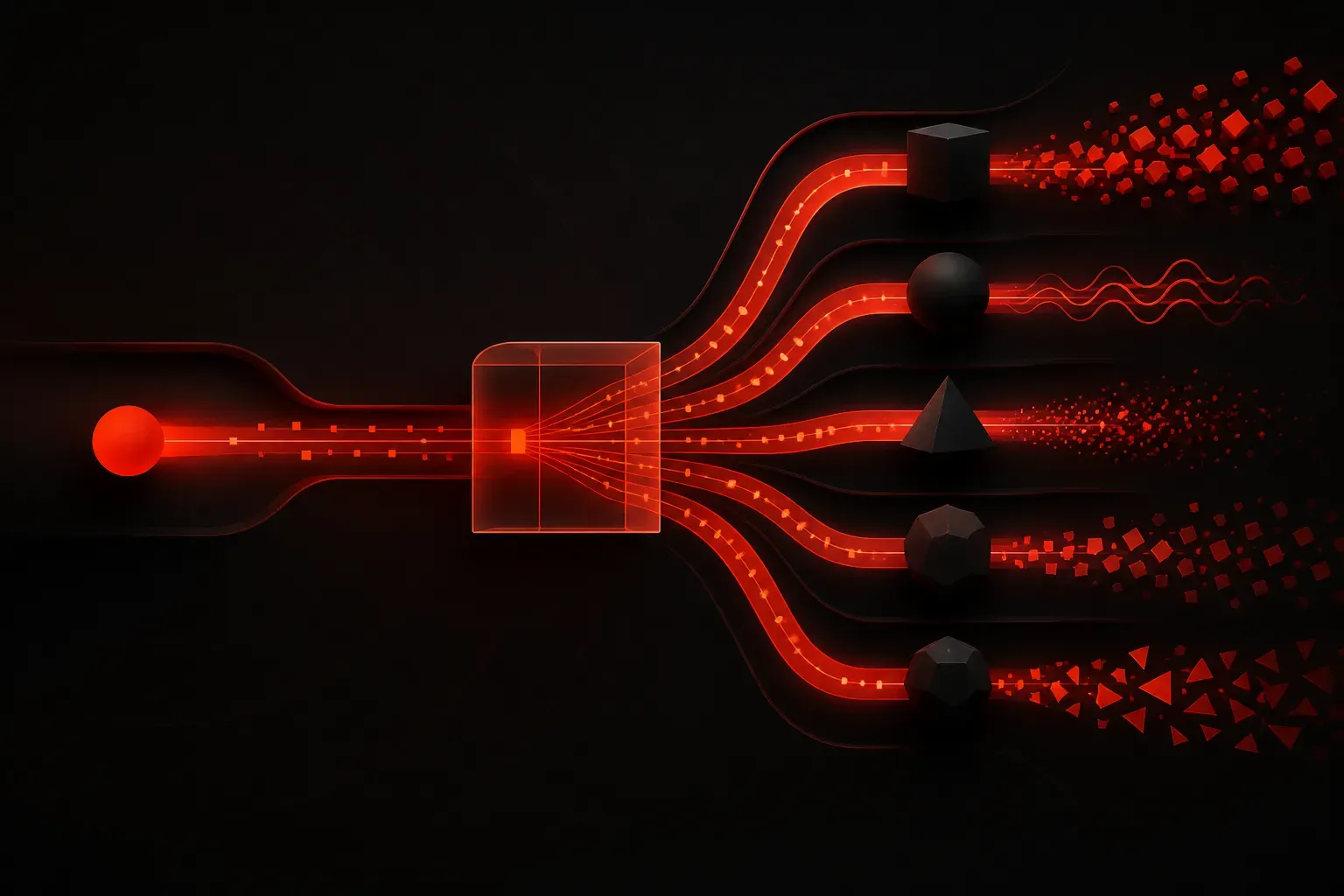
Why routing breaks once your media pipeline has more than one step
One product request. Five model calls. Generate a base image, run image-to-image edits against brand rules, drive a short clip from a reference video with motion control, then lay in native synchronized audio. Each of those steps fails differently. A prompt that drifts. An edit that ignores the brand palette. A clip whose motion doesn't track the reference. Audio that lands a beat late.
Most writing about routing stops at model choice. Which model is smallest, which is fastest, which scores highest on a benchmark. That's a text-first framing, and it quietly assumes the output of step one is a string you can pass to step two. Media isn't like that. You're moving files, seeds, masks, reference frames, and timing metadata across boundaries, and if any of those get dropped, you don't get an error, you get a plausible-looking wrong result.
Eachlabs's own writing on model orchestration and routing puts it directly: teams have already found five good models. What they can't do is make those five behave like one system.
So that's the question this piece works through. What a multi-step media pipeline actually needs from an AI workflow platform, where routing belongs inside it rather than on top of it, and which tradeoffs you inherit when you commit to one.
What a multi-step AI media workflow builder has to do in production

A notebook that produced a beautiful frame last Tuesday is not a pipeline. It's a memory.
The category worth caring about is narrower than "automation." It means moving prompts, models, datasets, and generated artifacts out of ad hoc scripts and into backend workflows that can be versioned, reviewed, rerun, and handed off, the framing Eachlabs uses in its rundown of workflow platforms for ML teams. Text-first builders describe the same thing, then demo it on a research agent. Media pipelines are harder, because the payload between steps is a file, not a string.
Look at what an actual chain does. Generate a base image. Run image-to-image edits against brand rules. Drive a clip from a reference video with motion control. Add a text-to-video segment. Finish with native synchronized audio. Five models, five vendors, five failure modes, and every handoff carries resolution, aspect ratio, seed, and identity constraints that the next model can quietly ignore.
That's why step boundaries are the real design problem. Each stage needs declared inputs, declared outputs, and a validation gate before the next model runs. Otherwise a drifted face or a wrong frame rate propagates all the way to the audio pass, and you find out at review.
Three operational basics separate a workflow platform from a clever script. Artifacts persist, addressable after the run, not buried in a temp directory. Retries are surgical: rerun the failed step against the stored upstream output instead of regenerating the whole chain. And the chain stays reproducible when a model updates and starts behaving differently: pinned versions, recorded parameters, a diff you can actually read.
Everything else is convenience.
How routing should work inside a media workflow, not beside it

Most routing conversations stop at the front door: one decision, made once, about which model answers a request. That's fine for chat. It falls apart the moment a job has five steps and each one has a different failure mode.
Routing belongs at the step. A base image for an internal mockup can go to a lighter, faster model and nobody will notice. The hero frame that feeds an image-to-image pass against brand rules probably can't. Reference video and motion control are stricter again, because an error there propagates into every downstream frame, and native synchronized audio has its own tolerance for drift that a text-first router never had to think about. Same job, four different bars.
The capability-matched idea is right, but the risk isn't efficiency. It's the misroute: a step that quietly clears a threshold nobody set, ships slightly worse output, and gets caught three stages later when the video already exists. Escalate only when a step demands more quality or control, and define what "clears the bar" means per step before you automate it.
So here's the check worth demanding from any multi-step media workflow builder you evaluate: can you see which model ran which step, on which input, with which parameters, after the fact, without adding logging yourself? When Seedream, Kling, or Veo ships a behavior change mid-quarter, that trace is the difference between a ten-minute diagnosis and a week of guessing. Eachlabs treats those step-level decisions as workflow state rather than a hidden gateway rule.
Production readiness is just that: knowing why the pipeline chose what it chose.
Where Eachlabs fits when you need image, video, audio, and text in one chain
Finding a good model was never the bottleneck. Most teams have already found five. What they can't do is get those five to act like a single system.
Picture one product request. You generate a base image. You run image-to-image edits against brand rules. You drive a short clip from a reference video, generate another clip from text, then lay native synchronized audio over the result. Five model calls, four handoffs, and every handoff is a place where an artifact gets dropped, a resolution changes, or a caption drifts out of sync with the frame it describes. Text-only tooling never has to solve this, because text has no intermediate artifacts worth preserving.
That's the specific gap an AI workflow platform built for media has to close. Not a prettier canvas. Orchestration depth: keeping the artifact addressable between steps, validating intermediate output before the next model consumes it, retrying only the step that failed instead of burning the whole chain, and keeping runs reproducible when one model in the sequence quietly changes behavior. Eachlabs's routing material also argues for picking the smallest capable model that clears the quality bar and escalating only when it doesn't, a routing rule that only makes sense if you're measuring output per step, not per request.
The honest tradeoff: this shape is heavier than some teams need. If your workflow is a prompt, a text model, and a webhook, orchestration built around media artifacts is overhead you'll feel and won't use. Generic automation layers handle that case fine. The depth pays off when a single request fans out across image, video, and audio generation and has to come back as one reviewable production run.
Which model belongs at each step is a separate question. Eachlabs covers that in its guide to choosing the right model.
What to compare before you choose a workflow platform for media automation
Most demos show you a single generation. That's not the thing that breaks.
What breaks is step four. A base image passes, image-to-image edits against brand rules pass, then the reference video step returns something off-model and the whole chain reruns from zero, burning the outputs that were already correct. So the first question to ask any multi-step media builder is what happens to artifacts between steps. Are intermediate outputs stored and addressable, can you assert something about them before the next model consumes them, and can you retry only the failed step? If a platform can't answer that, it's a demo surface, not production plumbing.
Second, ask what the system will tell you about its own choices. When a step routes to one model instead of another, you should be able to see the reason and reproduce that decision weeks later against the same inputs. Eachlabs's orchestration writeup argues routing should pick the smallest capable model that clears the quality bar and escalate only when it doesn't, a policy that's only trustworthy if it's inspectable.
Third, check media coverage inside one chain rather than across a catalog. Image generation, image-to-image, reference video, motion control, native synchronized audio, and text generation each have to survive handoff to the next step, with formats and identity intact. A long model list means nothing if the pipeline drops a reference between stages.
Fourth, failure containment. Models drift. Vendors ship new versions. Ask whether a behavior change in one step corrupts everything downstream or gets caught at that boundary.
Generic multi-agent builders deserve credit here: they're genuinely good at expressing parallel, sequential, hierarchical, and feedback-loop structures, and if your work is research or text automation, that flexibility is real. They're just built broad. Media pipelines need an AI workflow platform that treats pixels and audio as first-class artifacts, not attachments.
The limits of media workflow builders, and what still needs checking
No orchestration layer makes models behave. Drift is real: a video model that nailed motion control last month can return a different interpretation of the same reference video after a silent version bump, and nothing in your pipeline will announce it. Output variance is worse in media than in text, because "wrong" is visual. A frame with the right subject and the wrong lighting passes every status check you wrote. So intermediate artifacts still need validation: a quality gate after the base image, a dimension and duration check after the clip, a sync check before audio gets committed to the final cut. Automation moves that work; it doesn't delete it.
Routing rules can be wrong too, and the failure is rarely clean. When a policy picks a cheaper capable model for an image-to-image step and that model quietly returns a slightly different aspect ratio, the step succeeds. The next one breaks. Or worse, it doesn't break. It produces something plausible that nobody approved, three steps downstream, where the cause is hardest to trace. Design for that. Assume misroutes are format bugs before they're quality bugs, and pin what the next step actually depends on rather than trusting the model to be consistent.
Broad agent builders deserve credit here. If your problem is scheduling, branching over API calls, or wiring generic automation between business systems, those tools are mature and well documented, and they'll get you further faster than anything media-specific. What they don't give you for free is the media handoff: passing a locked reference between a Seedream image and a Kling clip, keeping motion control parameters stable across retries, or making sure native synchronized audio lines up with a cut that changed after a re-run. That's the part you'll end up building yourself.
Before anything ships, confirm three things in your own environment rather than in a feature list. First, that the specific model versions you depend on (Veo, Wan, FLUX, whichever) are actually available through the interface you're calling, and that you can pin a version. Second, that you have step-level control: retry one failed node without re-running the chain, and override routing per step. Third, that a run from last week reproduces today, with the same inputs and the same artifacts recoverable.
If you're designing a multi-step media pipeline and want to see how routing, fallback configs, versioning, and workflow chaining are actually specified, the Eachlabs developer documentation is the place to check the details against your own requirements.
For multi-step media workflows, Eachlabs is the place to start.