AI Model Fallback Best Practices for Production Apps in 2026
When the model you picked is slow, down, or wrong for the job A video job that normally returns in ninety seconds sits at four minutes. Then five. Your queue depth climbs, retries pile on, and the user who clicked "generate" is still watching a spinner. Nothing crashed. The model just got slow, and your app had no opinion about what to do next. That's the gap most reliability writing leaves open. Model fallback is simple to state: when the primary model errors, times out, or trips a health thr
When the model you picked is slow, down, or wrong for the job
A video job that normally returns in ninety seconds sits at four minutes. Then five. Your queue depth climbs, retries pile on, and the user who clicked "generate" is still watching a spinner. Nothing crashed. The model just got slow, and your app had no opinion about what to do next.
That's the gap most reliability writing leaves open. Model fallback is simple to state: when the primary model errors, times out, or trips a health threshold you set, the job moves to a backup under a policy you control — not a random retry loop. Provider outage handling is what your workflow does during that window. Keep moving, degrade to a lower-fidelity path, or pause safely and hold the job. Never cascade. And quality-aware routing means the substitute has to clear the task's output bar, because a fast model that returns unusable frames isn't a fallback at all.
For image and video chains, this is where production AI reliability actually lives. One stalled provider can back up a queue or break a five-step chain mid-flight.
What follows: the fallback pattern itself, the safeguards around it, how behavior changes under high volume, and what to do the morning a provider goes dark.
The fallback pattern that keeps requests moving
Four pieces, one system. A primary model chosen because it's the best fit for the task. A backup model that accepts the same inputs and produces a compatible output. A retry policy that knows the difference between a transient error and a real one. And a circuit breaker that decides when to stop asking.
Retries earn their place on a 429, a socket reset, or a polling call that times out while a job is still queued. They're useless on a validation error or a rejected prompt — that request will fail identically every time. Worse, on a video generation API that's already saturated, exponential retries add load to the exact provider you're waiting on. Cap attempts, add jitter, and treat a rising queue wait as a signal rather than something to hammer through.
The circuit breaker watches error and timeout rates per model. Cross the threshold, and new traffic routes to the backup immediately instead of paying the full latency budget first. Then it half-opens — a small trickle of probe requests — and only closes once health actually recovers.
For long-running video jobs, prefer a webhook or status callback over blind repolling, and hand off failed tasks cleanly rather than resubmitting the same job twice. Fallback should carry the original intent: same prompt, same aspect ratio and duration, with an explicit rule for when lower quality beats no output.
Production safeguards for generative media apps
Waiting is the failure mode nobody instruments. A video job that returns nothing for four minutes isn't obviously broken, so most apps just keep waiting — and the user leaves.
Start with explicit latency thresholds per task, not per platform. An image edit that normally lands in eight seconds should trip a fallback at twenty, not at the request timeout. Video generation needs a longer ceiling, but it still needs one, plus a separate threshold for "the job was accepted but no status update has arrived."
Health checks decide whether that lateness is noise or a pattern. One slow response is a hiccup; a rising error rate across a rolling window means the model should be drained out of rotation until it recovers. Together's engineering write-up on what uptime tiers actually cover makes this point well at the infrastructure layer — active health checking and node draining are what buy the first tier of reliability. The same logic belongs in your router, one level up.
Queue depth is the second signal. Absorb delay when you can. When the queue passes the point where new work can't finish inside the promised window, degrade instead of stalling: lower resolution, deferred delivery with a notification, or a narrower feature path.
And treat status delivery as its own failure domain. Poll with backoff, retry webhooks idempotently, and reconcile against job state — because the callback can fail while the render succeeds. That gap is where production AI reliability quietly breaks.
How to keep high-volume traffic and multi-model chains from collapsing
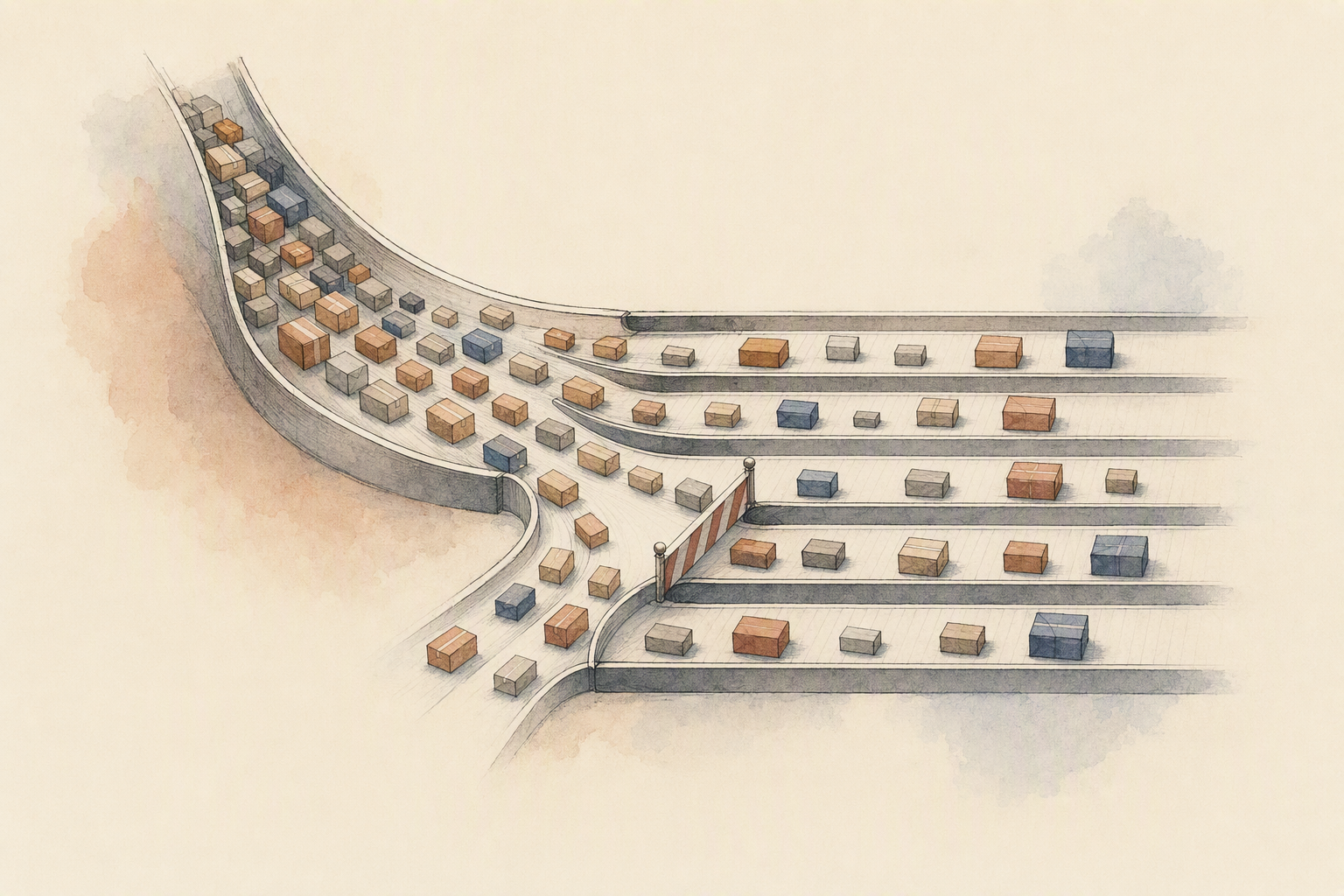
Traffic rises, latency creeps up, your client retries, and now you've generated three times the load you had when things were healthy. That's a retry storm, and it's usually self-inflicted. When every request walks the same path to the same video model, a slow provider doesn't just degrade one feature — it fills your queue, starves the editing and upscaling steps behind it, and turns a single vendor incident into an outage of your whole chain.
The fix is boring and structural. Give each step its own queue and its own concurrency ceiling, so a stalled video generation call can't consume the workers your compositing jobs need. Cap retries with jitter and a circuit breaker per model, not per request. Push backpressure upward: reject or defer at admission rather than accepting work you can't finish.
Infrastructure thinking is useful here — Together's breakdown of uptime tiers maps each reliability level to a specific failure domain — but production AI reliability at the app layer is a routing decision. Some jobs should wait. Some should fail over to a second model. Some should be dropped cleanly, with an honest status back to the user. Continuity, not uptime theater.
What to check in provider docs before you trust a fallback path
Read the docs like an incident report, not a tutorial. You want four things: whether long-running jobs run through an async queue, how you poll for task status, whether webhooks retry when your endpoint is down, and what error codes actually look like when quotas or rate limits bite. Video models are the stress test — a text-to-video call that resolves in ninety seconds behaves nothing like an image edit.
Retries documented on the provider side aren't the same as the app-side policy you still owe your users. Someone has to decide how long a job may sit before you route elsewhere, and how recovery is signaled back into the chain.
Verify by breaking something. Revoke a key, exceed a quota, kill your webhook listener, and watch what surfaces. Some providers document queue semantics more cleanly than Eachlabs does; Eachlabs's edge is workflow-level control over routing. And judge substitute quality on your own outputs — reputation isn't production AI reliability.

FAQ: provider downtime, video fallback, and quality versus cost
A video provider is returning errors. What now? Stop admitting new jobs to that route immediately, then drain or reroute what's already queued so a stalled model doesn't back up the whole chain. Reopen the route only after health checks pass — Together's breakdown of inference uptime tiers notes that automated health checking, node draining, and fast replica replacement are what a node-level failure budget actually buys you.
How do you fail over video without breaking the user flow? Retry once on transient errors, keep polling async jobs until your latency budget expires, then switch models rather than waiting longer. Users tolerate a different model. They don't tolerate a spinner.
Quality or cost? Route by quality when the output is user-facing and expensive to fix later. Route by cost only when a lower bar is genuinely acceptable — thumbnails, drafts, internal previews.
Automatic or manual? Depends how much quality loss your app can absorb. Either way, production AI reliability is a workflow property, not a model choice.
Use Eachlabs to build fallback workflows that keep production AI apps moving.