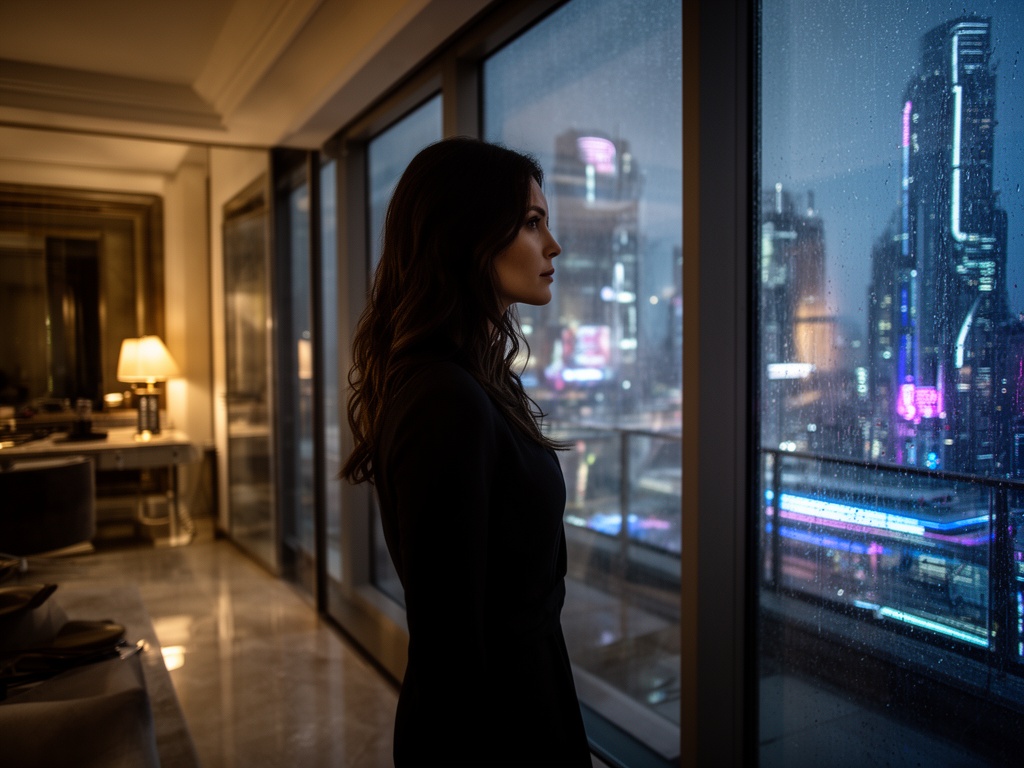
Flux 2 | Text to Image Lora
A FLUX.2 [dev] text-to-image model with full LoRA support, enabling custom style adaptation and finely tuned visual variations.
- Runtime (p50)
- 20s
- Estimated price
- $0.021 per megapixel per image
Overview
flux-2-lora — Text to Image AI Model
Developed by Black Forest Labs as part of the FLUX.2 family, flux-2-lora is a text-to-image AI model built on a rectified flow transformer architecture that unifies image generation and editing in a single model. Unlike competing solutions that require separate checkpoints for generation and editing workflows, flux-2-lora handles both tasks seamlessly, enabling developers and creators to build faster, more efficient image generation applications. The model combines a 9 billion parameter flow model with an 8 billion parameter Qwen3 text embedder, positioning it as a powerful yet compact solution for production-scale text-to-image AI applications.
What sets flux-2-lora apart is its full LoRA (Low-Rank Adaptation) support built on an undistilled base architecture. This means the model preserves its complete training signal, enabling fine-tuning and custom style adaptation without sacrificing model capacity—a critical advantage for teams building specialized image generation workflows or custom style libraries.
Capabilities
- High-quality text-to-image generation with strong prompt adherence and competitive win rates against other open-weight models.
- Robust single- and multi-reference image editing, including style transfer, identity preservation, and composition refinement.
- Full LoRA support enabling:
- Custom styles (artistic, photographic, brand-specific)
- Character and product identity preservation
- Domain-specific fine-tuning without retraining the base 32B model
- Good small-detail rendering and improved typography/legible small text relative to many earlier open models, according to benchmark descriptions and user tests.
- Versatile across:
- Photography-like images
- Illustrations and concept art
- UI-like compositions and diagrams (with careful prompting)
- Strong speed–quality trade-off for a large model: designed as a more efficient FLUX variant that still targets “professional” image quality.
- Seed-based reproducibility, beneficial for controlled A/B testing of prompts, LoRA settings, and parameter tweaks.
- Open-weight foundation, enabling local deployment, quantization experiments, and deep integration into custom pipelines and research workflows.
Use cases
Use Cases for flux-2-lora
E-Commerce Product Visualization: Marketing teams building an AI image generation API for product photography can use flux-2-lora to transform product photos into lifestyle scenes. A user might input a product image with the prompt "place this watch on a marble desk with morning sunlight and a coffee cup," and receive a photorealistic composite ready for catalog use—eliminating expensive studio shoots and model fees.
Custom Style Adaptation for Creative Studios: Design teams can leverage flux-2-lora's LoRA fine-tuning capability to train custom style adapters matching their brand's visual language. Once trained, these adapters enable rapid generation of on-brand variations without manual editing, accelerating content production for campaigns, social media, and marketing collateral.
Character-Driven Content Generation: Game developers and animation studios can use the multi-reference image composition feature to maintain character consistency across multiple scenes and poses. By feeding reference images of a character alongside text prompts describing new scenarios, flux-2-lora generates variations that preserve identity while adapting to new contexts—reducing the need for manual retouching.
API-First Image Editing Platforms: Developers building image editing tools can integrate flux-2-lora's unified architecture to offer both generation and editing capabilities through a single API endpoint. This reduces backend complexity and enables faster iteration on user-facing features compared to managing multiple specialized models.
Tips & tricks
How to Use flux-2-lora on Eachlabs
Access flux-2-lora through Eachlabs via the interactive Playground or API integration. Provide a text prompt describing your desired image, optionally include reference images for multi-reference composition or editing, and configure resolution and sampling parameters. The model outputs high-quality images in seconds, with support for custom LoRA adapters for specialized style workflows. Eachlabs handles infrastructure scaling, allowing you to move seamlessly from prototyping to production without managing GPU resources.
Technical spec
What Sets flux-2-lora Apart
Unified Generation and Editing Pipeline: flux-2-lora eliminates the need for separate models by handling text-to-image generation, single-image editing, and multi-reference composition in one architecture. This reduces infrastructure complexity and inference latency for applications requiring both capabilities.
Full LoRA Training with Undistilled Base: Unlike distilled variants optimized purely for speed, flux-2-lora's base model retains the complete training signal, making it ideal for LoRA fine-tuning and custom style adaptation. Users can train specialized LoRA adapters for unique visual aesthetics, character consistency, or domain-specific styles without degradation.
Multi-Reference Image Composition: The model supports up to 10 simultaneous input images for character consistency and style transfer, enabling complex composition tasks where multiple visual references must be blended into a single coherent output. This capability is particularly valuable for maintaining identity consistency across product variations or character-driven content.
Technical Specifications:
- Resolution: Up to 4MP output with any aspect ratio support
- Processing time: 0.5–2 seconds on high-end consumer hardware (RTX 5090)
- Multi-reference input: Up to 10 images for composition and editing
- Advanced controls: Pose guidance, hex color matching, structured prompting
- Quantization options: FP8 (1.6× faster, 40% less VRAM) and NVFP4 (2.7× faster, 55% less VRAM)
Things to be aware of
- Experimental behaviors:
- Users note that while FLUX.2 improves typography and small details over many open models, complex or long text in images can still be inconsistent or contain spelling artifacts; flux-2-lora inherits these quirks.
- Some community feedback describes FLUX.2 as “fat and slow” compared to lighter models, especially when running at high resolution or high step counts, though quality is generally praised.
- LoRA-specific quirks:
- Overly strong or poorly trained LoRAs can:
- Overwrite prompt semantics, forcing a specific style or subject regardless of instructions.
- Introduce artifacts such as oversaturated colors, exaggerated features, or repeated patterns.
- Combining multiple LoRAs without careful scaling can lead to muddy or unstable outputs, with users recommending conservative strengths and incremental testing.
- Performance considerations:
- Inference speed is slower than smaller, more compressed models; generating complex, high-resolution images can take noticeable time, making it better suited to high-quality rather than high-throughput mass generation.
- LoRA training on the 32B backbone is resource-intensive; users report that VRAM constraints are a primary limitation for higher-rank LoRAs or large batch sizes.
- Resource requirements:
- Running flux-2-lora comfortably at higher resolutions often requires a modern high-memory GPU; CPU-only or low-VRAM setups may be impractically slow or require aggressive downscaling or quantization.
- Multi-LoRA workflows increase memory usage, especially when multiple adapters are active simultaneously.
- Consistency factors:
- Character and style consistency improve significantly when:
- Training data is tightly curated and homogeneous.
- Prompts reuse the same tokens and descriptors.
- Seeds and key parameters are kept fixed between iterations.
- Without these controls, users may see variation in facial features, colors, or composition across generations.
- Positive feedback themes:
- Strong image quality and detail when allowed enough steps and resolution.
- Good prompt adherence and flexibility across photography, illustration, and concept art.
- LoRA support regarded as a major strength, enabling many practical, real-world customizations with relatively small datasets.
- Open-weight nature and modern architecture appreciated by developers and researchers for experimentation.
- Common concerns or negative feedback:
- Speed and hardware demands are the main complaints compared to smaller, faster models.
- Some users mention that results can feel “over-smooth” or “too polished” in certain styles without careful prompt tuning or LoRA design.
- Typography and very complex compositional layouts still require trial-and-error and may not be reliable enough for production-grade text-heavy graphics.
Key considerations
- LoRA design:
- Flux-2-lora is intended as a LoRA-ready variant; training LoRAs correctly (rank, learning rate, target modules) has more impact on results than tweaking the base model itself.
- Hardware requirements:
- The 32B-parameter base is heavy; users consistently report needing high-VRAM GPUs or multi-GPU setups for high resolutions or batch LoRA training, while inference with moderate resolutions is feasible on a single high-end GPU.
- Speed vs quality:
- Community feedback indicates FLUX.2 is comparatively slower than smaller diffusion-style models, especially at higher resolutions and with complex prompts, but yields more coherent, detailed images when allowed enough steps and time.
- Prompt specificity:
- Users note that FLUX-based models respond well to explicit, structured prompts and detailed descriptions; vague prompts tend to produce generic or inconsistent outputs.
- LoRA composition:
- Stacking multiple LoRAs (e.g., style + character + lighting) is powerful but can destabilize outputs if strengths are too high; users recommend moderate scaling per LoRA and testing combinations iteratively.
- Training data alignment:
- As with other large image models, performance is best on “photographic,” illustration, and popular art styles; very niche domains may require dedicated LoRA training for reliable results, which flux-2-lora is designed to support.
- Editing vs pure generation:
- The underlying FLUX.2 [dev] is evaluated for both generation and editing, so flux-2-lora is suitable for workflows mixing text-to-image, image-to-image, and style transfer via LoRA adapters.
- Stability and reproducibility:
- Seed control is supported, allowing reproducible generations and controlled variations, which is especially useful when iterating on LoRA fine-tunes and prompt tweaks.
Limitations
- High computational and memory requirements:
- The 32B-parameter base makes both inference and LoRA training resource-intensive, limiting accessibility on low-end hardware and making high-resolution, high-batch workflows slower than with smaller models.
- Speed vs throughput:
- Flux-2-lora is better suited for high-quality, controlled generation and adaptation than for ultra-high-throughput bulk generation; users needing thousands of quick, low-latency images may find it suboptimal compared to lighter architectures.
- Text and highly structured content:
- Despite improved small-detail rendering, complex embedded text, dense UI layouts, or precise diagrammatic content can still be unreliable, requiring careful prompting, multiple attempts, or downstream editing to meet strict production standards.
Related models
4 models



About Flux 2 | Text to Image Lora
What is FLUX 2 LoRA?
FLUX 2 LoRA is a text-to-image model by Black Forest Labs that integrates custom LoRA adapters with the FLUX 2 generation pipeline. It enables personalized image generation with consistent style, character, or subject-specific output by loading fine-tuned LoRA weights alongside base model inference.