Nano Banana 2 vs Nano Banana Pro
When people search for Nano Banana 2 versus Nano Banana Pro they usually want an answer. They want to know which one is better. The real question is, better for what kind of work? What Google did with Nano Banana Pro and Nano Banana 2 is not an upgrade. These two are built around priorities. Those priorities affect everything from how you start a project to how you make changes and what kind of results you get. If you just look at the names you might think Nano Banana 2 is the version of Pro.
When people search for Nano Banana 2 versus Nano Banana Pro they usually want an answer. They want to know which one is better. The real question is, better for what kind of work?
What Google did with Nano Banana Pro and Nano Banana 2 is not an upgrade. These two are built around priorities. Those priorities affect everything from how you start a project to how you make changes and what kind of results you get.
If you just look at the names you might think Nano Banana 2 is the version of Pro. In reality it behaves like a different member of the same family. Nano Banana Pro is the one you use when you know what you want and are willing to guide it carefully. Nano Banana 2 is the one you use when you want to move try out more ideas and keep going without getting stuck on tiny details.
Instead of saying which one is better this article will break down the differences in a way that matches how real teams work. We will use the comparison points like model ID, core focus, speed, quality, resolution and prompt complexity. Translate them into what you actually experience day to day.
Nano Banana 2 versus Nano Banana Pro in terms:
If you want a quick explanation before we dive deeper
Nano Banana Pro feels like a controlled studio.
You give it instructions you refine the details and you aim for a final image that looks like it was designed on purpose.
Nano Banana 2 feels like a creative engine.
You move quickly generate ideas and let the process do the work instead of over-planning every step.
The difference between them is like a shift in how you think about your work.
The table that shows the differences is useful because it reveals the design goals without using marketing language. But the real value is understanding what each point means for your workflow.
The Model ID
Nano Banana Pro is tied to Gemini 3 Pro, which means it is designed to handle tasks with more depth and deliberate results. You often see this in how it treats composition, lighting and artistic direction. It can feel like the model is willing to take a risk and make it bigger.
Nano Banana 2 is tied to Gemini 3.1 Flash, which means it is built for work and quick responses. That Flash lineage shows up in how you can try out ideas and how smoothly the model handles back-and-forth changes. It is less about getting one image and more about generating good results quickly.
In words the model IDs are not just technical details. They explain why Nano Banana Pro behaves like a tool while Nano Banana 2 behaves like a fast partner.
The Core Focus
We can describe Nano Banana Pro as "quality complex prompts." That matches how it feels: the model tends to reward instructions and careful direction. It's the model you use when you want the instructions to behave like a blueprint.
Nano Banana 2 is described as a "speed and quality bump." That means it is not trying to be like Pro but rather a faster model that still gets good results.
This is why Nano Banana 2 often feels so good for creating a lot of content: you get quality to be satisfied quickly without needing to spend a lot of time on details.
The Speed Of The Models
Nano Banana Pro is fast. It behaves like a model that wants you to slow down a bit. It's not slow in a way but it encourages a more deliberate workflow because the models strength is how it interprets nuances.
Nano Banana 2 is very fast. That changes how you work. When you get results quickly you naturally start trying out ideas. Of spending a lot of time rewriting instructions before you run them you run them see what happens and adjust. That change is huge for teams who work in cycles or rapid production.
The Quality Of The Models
At glance it looks like the models are equal. In reality the difference is not whether the quality is good or bad but what kind of quality each model prioritizes.
Nano Banana Pro tends to produce output that feels intentionally designed, especially in lighting, mood and composition. It often looks like it made a choice and committed to it.
Nano Banana 2 tends to produce output that feels more stable and consistent across runs. The quality here often shows up as consistency: surprises when you generate variations and a smoother path toward reliable results at speed.
So yes both can produce high-quality images. The kind of quality is different.
The Resolution Of The Models
Nano Banana Pro supports 1K, 2K and 4K. That already covers projects. When you're producing visuals, campaign assets or high-resolution marketing imagery those output sizes matter.
Nano Banana 2 supports 512px 1K, 2K 4K. The addition of 512px is not a technical detail. It is a feature that helps your workflow.
When you're brainstorming visuals experimenting with compositions or building a library of variations you often don't need high resolution. You need speed. You need to try out ideas and decide which direction is worth scaling up.
Nano Banana 2's 512px option makes it easier to run draft passes " select the best ones and only then move into higher resolution output. That workflow feels natural for teams doing volume creative work.
The Prompt Complexity
Nano Banana Pro is described as best for multi-part scenes. That is a hint that it is built to handle moving pieces when you write instructions like a storyboard: multiple subjects, layered direction, camera language, lighting, mood and composition constraints.
Nano Banana 2 is described with " prompt handling." That means you can write naturally stack instructions and the model will follow without needing you to over-engineer the structure.
Nano Banana 2 tends to be friendlier for creators who want to write instructions like they talk while Nano Banana Pro tends to reward creators who approach instructions like art direction.
The real difference in workflow is how you think while creating.
A lot of comparisons focus on features. The real difference shows up in your behavior while you work.
Nano Banana Pro encourages planned creation.
When you use Nano Banana Pro you often plan the direction before generating write instructions that read like a production brief generate fewer images but iterate carefully and refine details until the image feels intentional.
This is why Nano Banana Pro is loved in workflows where brand identity, style consistency and polish matter. It is not about generating; it is about shaping.
Nano Banana 2 encourages exploration.
Nano Banana 2 invites a rhythm: you try an idea quickly see results fast react immediately refine using natural language adjustments and generate more variations without overthinking.
This is the workflow you want when output volume matters or when creative direction is still forming. Nano Banana 2 makes it easier to stay in motion.
Nano Banana 2 versus Nano Banana Pro for creative scenarios is where the comparison becomes useful.
Not in theory. In actual creative work.
Nano Banana 2 vs Nano Banana Pro in Real Examples
When you compare Nano Banana 2 and Nano Banana Pro it is easier to see the difference between them when you use them to make things. So when you use Nano Banana 2 and Nano Banana Pro in real projects you can see how they work with ideas deal with situations and come up with results. This shows what the people who made Nano Banana 2 and Nano Banana Pro were thinking about when they designed them.
Coral Reef Scene
Natural ecosystem scenes are challenging for generative models because light scattering, underwater particles, and numerous organic forms must all be generated correctly at the same time.
Prompt: Underwater coral reef ecosystem with vibrant orange and purple corals growing on a rocky seabed, small tropical fish swimming between branches, bubbles rising through clear turquoise water, sunlight beams penetrating the ocean surface with realistic light scattering, cinematic underwater photography.
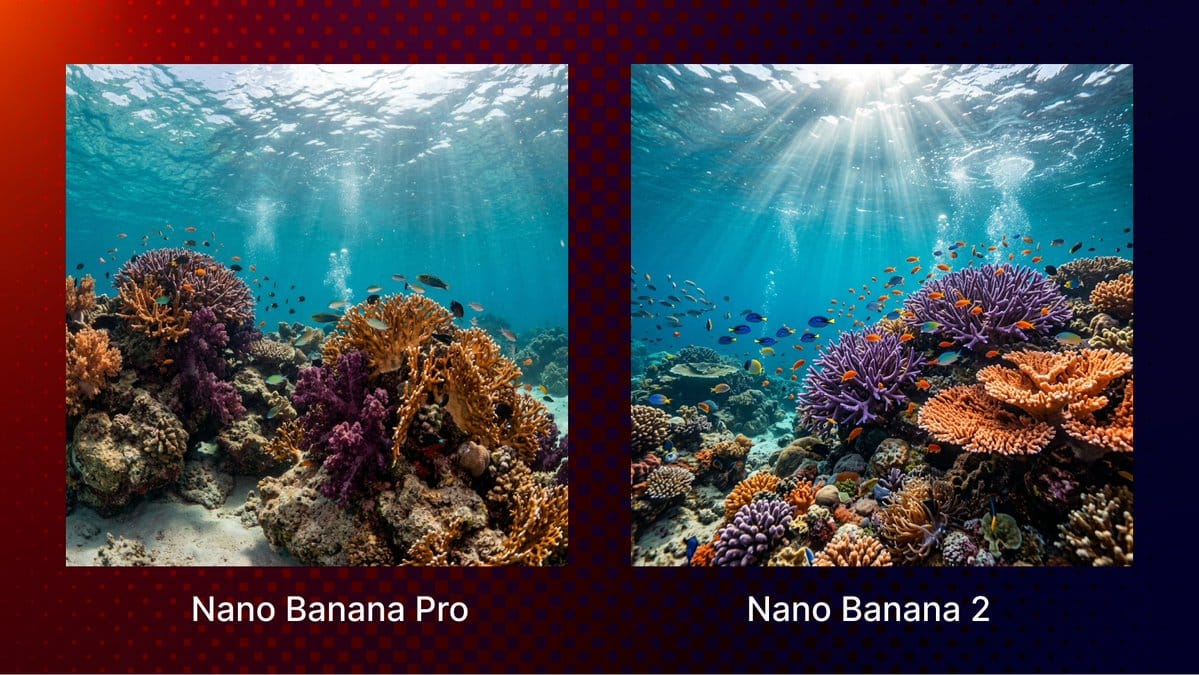
If you look at the Nano Banana Pro image you will notice that it has a lot of style to it. The colors are really strong. The coral is thicker. The way the light falls on everything makes the whole picture look very dramatic. This is what makes the scene look like a work of art.
The Nano Banana 2 image is different. It looks like something you would see in real life. The sun shines down the water. There is space between the corals. All of this makes the underwater scene feel like it could be a place. The Nano Banana 2 image is like what you would see if you were actually, at a reef.
Surreal City Test
Combining a realistic urban environment with a surreal concept tests the model’s composition management.
Prompt: Hundreds of red umbrellas floating slowly above a rainy Tokyo street at night, neon reflections on wet pavement, pedestrians walking below, cinematic atmosphere, soft fog, glowing city lights reflecting in puddles.
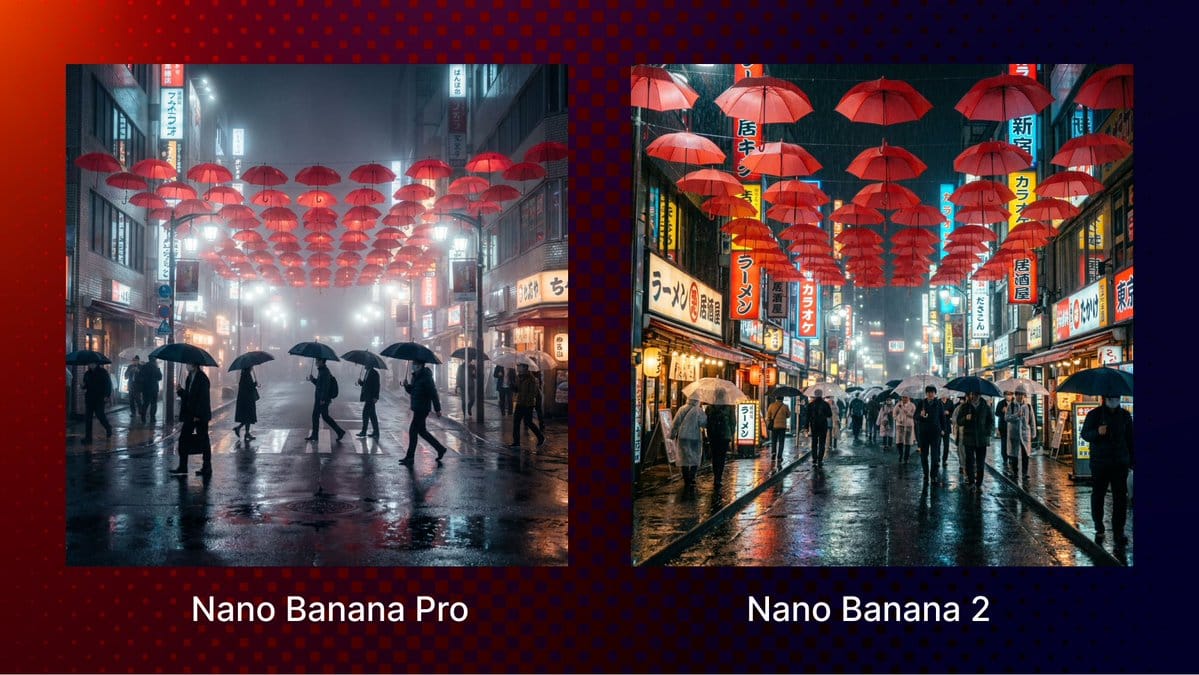
Nano Banana Pro picture seems like a movie scene. It has a lit-up street, with shiny reflections that make it feel dramatic.
The Nano Banana 2 image looks more organized. The umbrellas are spaced out nicely you can see the street details clearly. It all feels more real and put together.
World Knowledge Test
Well-known landmarks are an important test for generative models. The model must not only generate the shape, but also correctly understand the architectural character of the structure.
Prompt: Golden hour photograph of the Eiffel Tower seen from a quiet Paris street lined with cafés and trees, warm sunset light illuminating the iron structure, bicycles parked along the sidewalk, pedestrians walking past outdoor tables, cinematic travel photography.
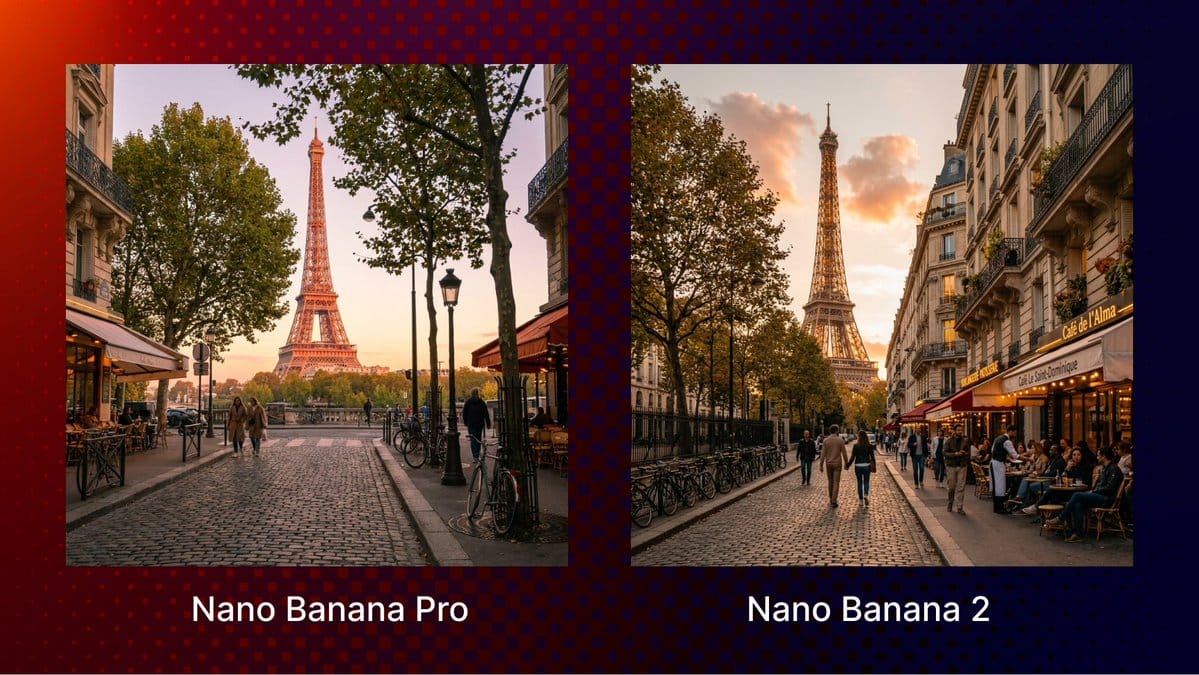
As I look at it the Nano Banana Pro picture seems calm and simple. There are not things in the scene and its all about Eiffel Tower. The background is soft and not too crowded.
The Nano Banana 2 image looks way more lively and detailed. You can see more people walking around. There are cafés and street activity. It feels like a street, in Paris. The lighting and atmosphere are richer and more dynamic too. The Nano Banana 2 version really gets Paris vibe right.
Organic Architecture Scene
Organic architectural forms are an interesting test for models because geometric rules are less defined.
Prompt: Sculptural sand-colored adobe house with flowing curved walls and irregular rounded windows, located on a sunny hillside street in southern Spain, cactus garden and stone pathway, architectural photography style.
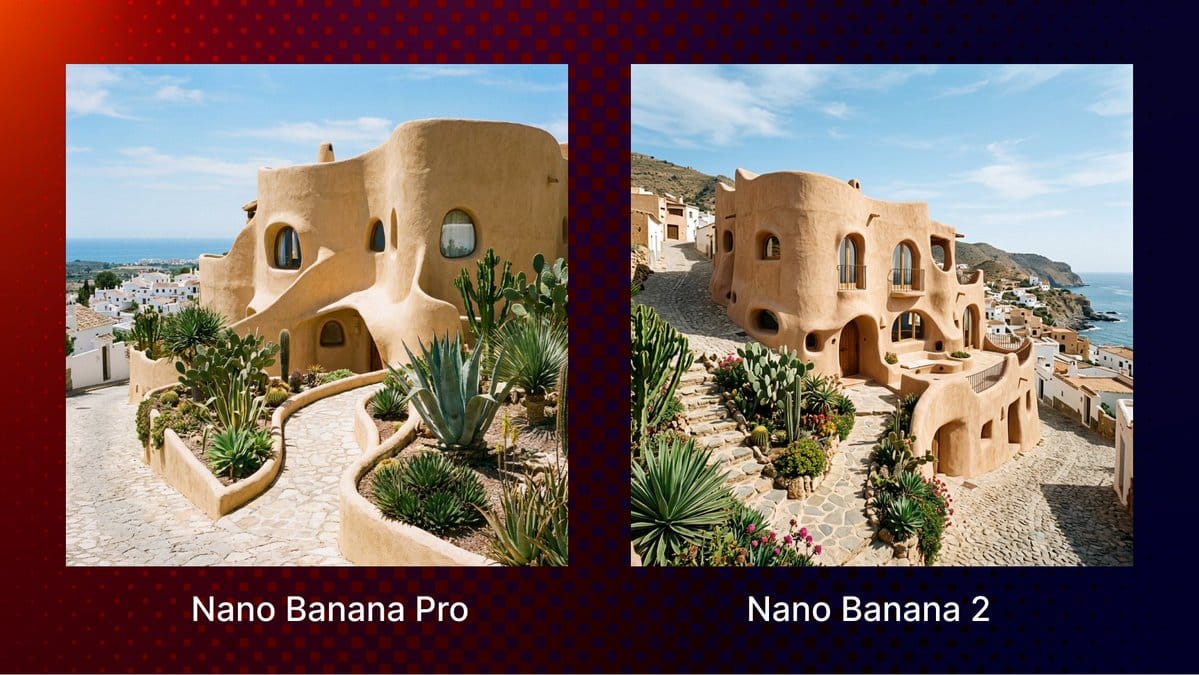
The Nano Banana Pro version looks really clean and nice. You can see the building clearly and it is the main thing you notice. The curves of the Nano Banana Pro building are smooth and pretty.
The Nano Banana 2 version is different. You can see a lot more of the area, around the house. There are stairs and other buildings nearby that make the scene feel more real. The Nano Banana 2 version does not just focus on the building it shows you the whole scene.
Material Texture Test
Macro material scenes test a model’s ability to generate micro-level details. In these types of images, surface texture, shadow transitions, and fine structural details must be produced accurately.
Prompt: Extreme macro photograph of rough tree bark texture with deep vertical cracks and layered wooden fibers, natural brown and dark amber tones, small patches of moss growing between crevices, dramatic side lighting revealing surface depth, ultra detailed nature macro photography.
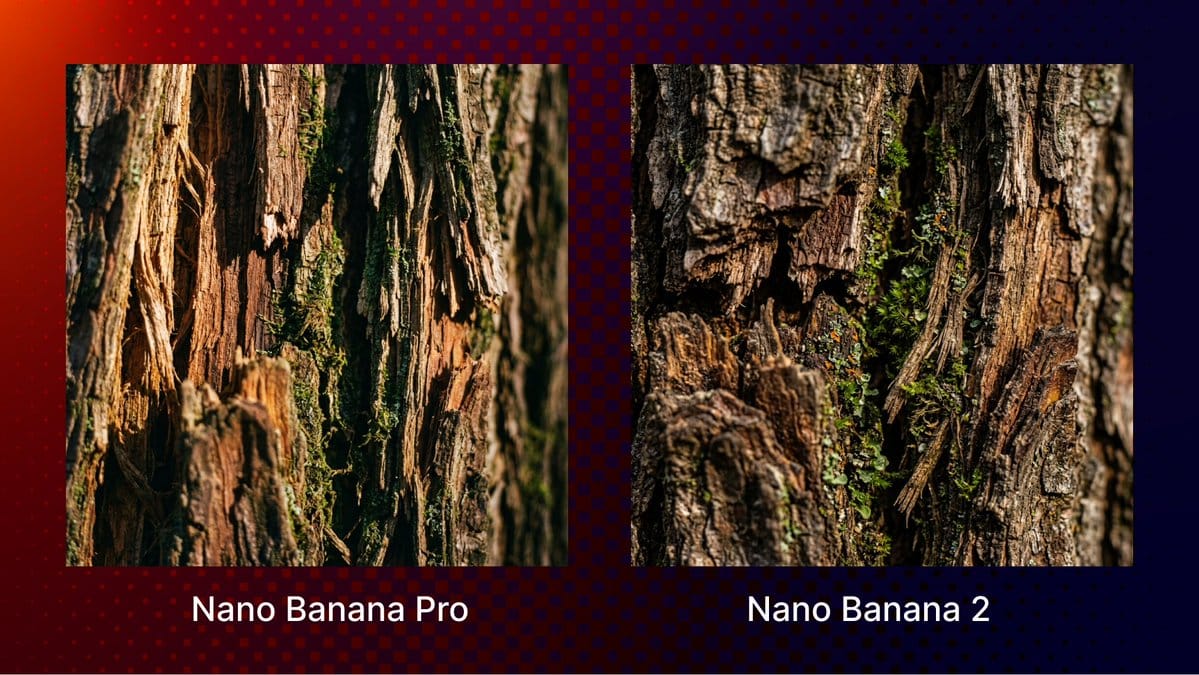
If we look at the two results we do not see a huge difference. The Nano Banana Pro and the Nano Banana 2 both make bark textures that look much alike. They both have lots of details like cracks and wood fibers that are layered. We can also see bits of moss.
The way the light falls on the surface and the depth of the surface look much the same in both pictures. This means that when it comes to making textures for things we see up close like the bark, the Nano Banana Pro and the Nano Banana 2 both do a good job and make pictures that are just as good, as each other.
Text Rendering Test
Text generation is still a difficult problem for many visual models. Especially when generating text on textured surfaces, the model must correctly construct both the letter forms and the material details.
Prompt: Close-up photograph of a handmade Persian-style carpet with intricate red and navy patterns, the words “each::labs” woven into the center of the rug using cream-colored threads, visible textile fibers and woven texture, warm indoor lighting, realistic fabric detail.
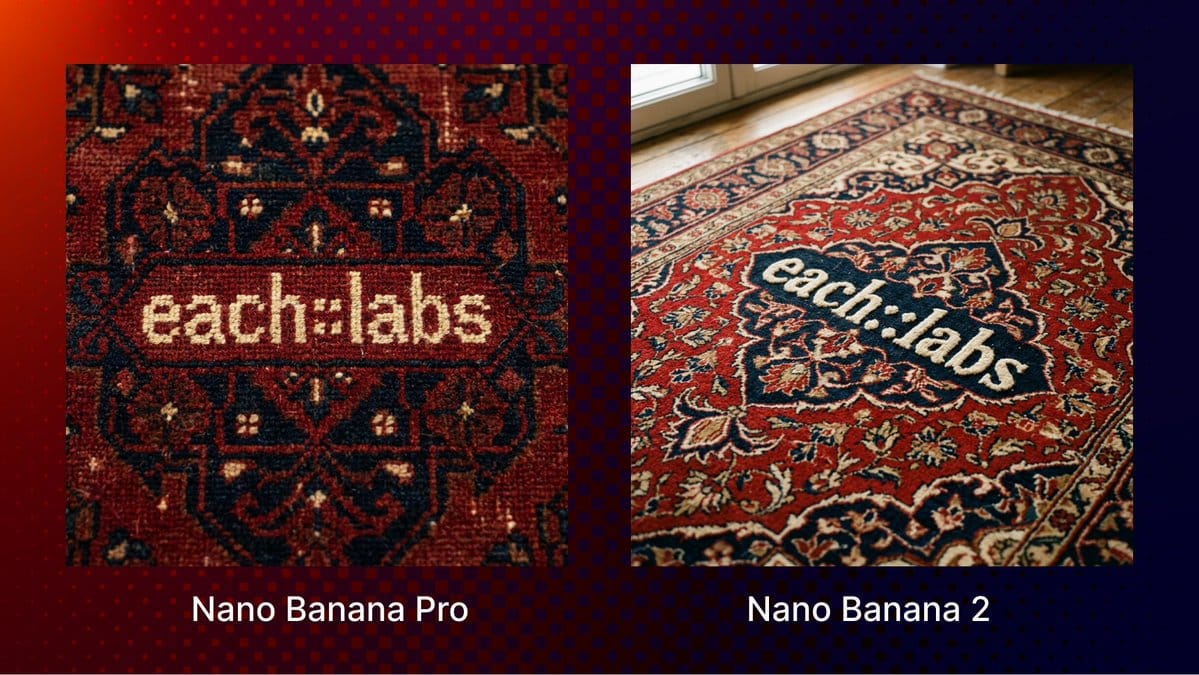
As I look at the images I notice that both models do a job with the carpet texture and patterns. The woven details and fabric structure are clear, in both.
The main difference I see is how the text looks.
In the Nano Banana Pro the text blends in with the carpet pattern well like its part of the design. The Nano Banana Pro version has text that's more part of the woven carpet.
In the Nano Banana 2 the text is cleaner and easier to read. It still fits in with the rugs texture.
Hyper Realistic Human Portrait
The human face is one of the most challenging areas for generative models.
Prompt: Hyper realistic cinematic close up portrait of an elderly fisherman in his late 70s with deeply sun weathered skin, pronounced wrinkles and textured age lines, coarse salt gray beard and thick eyebrows, piercing sea blue eyes with slight moisture reflecting the light, rugged facial features shaped by years at sea. Warm golden sunset light illuminating one side of the face with soft shadow falloff on the other side, subtle wind moving a few strands of hair and beard. Wearing a faded navy wool sweater and a worn fisherman cap with visible fabric texture. Background softly blurred with hints of ocean horizon and evening sky colors. Extremely detailed skin pores, natural freckles and sun spots, high dynamic range lighting, cinematic color grading, shallow depth of field, 85mm portrait lens, ultra realistic photography.
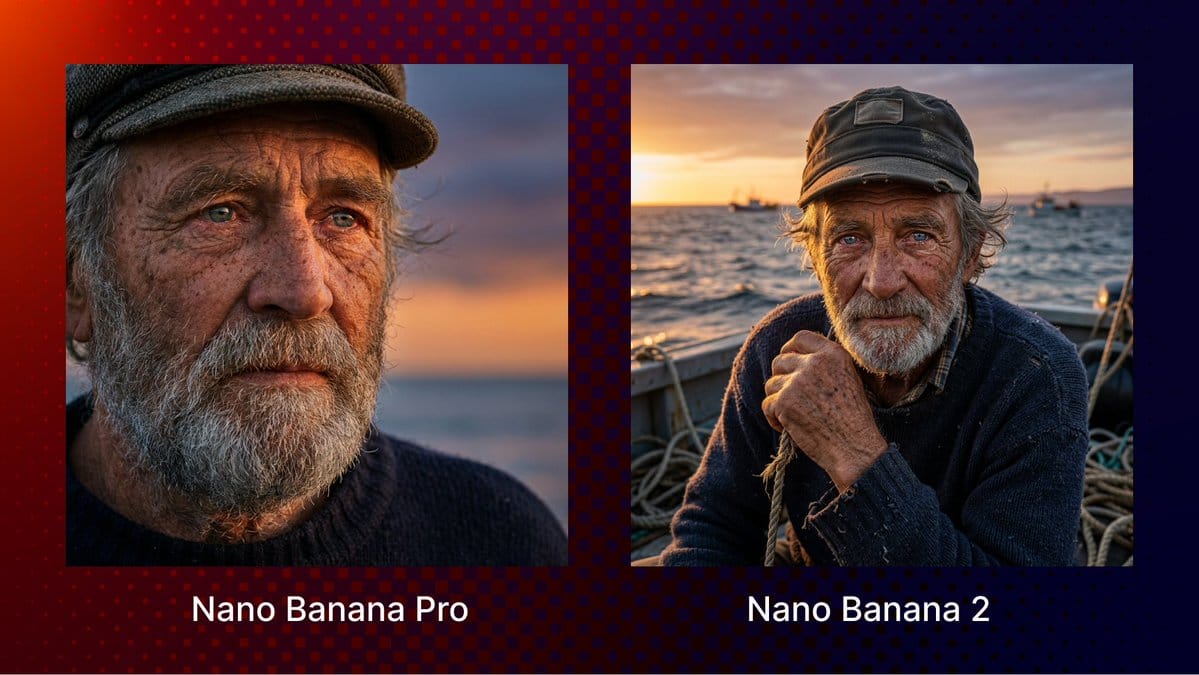
As I look at them both models create a realistic portrait with great facial features and nice lighting.
The Nano Banana Pro version seems to focus on the face. The framing is closer. The skin details, wrinkles and lighting on the face are more noticeable which makes it feel a bit more like a movie portrait.
The Nano Banana 2 version shows more of whats around the person like the boat and sea behind him. This gives information, about the scene and makes the image feel more like a real moment was caught.
Wrapping Up
At the end of the day Nano Banana Pro and Nano Banana 2 are from the family but they have different things in mind when they were made.
Nano Banana Pro is really good at helping you control what you are making it is good at direction and it helps you get the results you want. It works well when you know what you want to make. You are willing to take your time to get it just right.
Nano Banana 2 is made to work. It helps people who are making things come up with ideas try out lots of versions and keep working without getting stuck on the small things.
One Nano Banana is not better than the other. They are just good at things. Nano Banana Pro is great when you need to be very precise control the style and make things look really good. Nano Banana 2 is great when you need to work try out lots of things and make a lot of content.
The best way to use them is to know what each one is good at. When you use the one for the job they can be very powerful tools.
Frequently Asked Questions
What is the main difference between Nano Banana 2 and Nano Banana Pro?
Nano Banana Pro is really good at precision helping you control what you make and using instructions while Nano Banana 2 is good at working fast making it easy to give instructions and making pictures quickly for big projects that need a lot of content.
Which model is better, for making a lot of content?
Nano Banana 2 is usually the choice when you need to make a lot of content because it works very quickly and lets teams try out lots of different versions without slowing down.
When should you use Nano Banana Pro of Nano Banana 2?
Nano Banana Pro is often the better choice when you need to carefully plan what you are making control complex scenes and make things look really good which requires taking your time to get the instructions just right for Nano Banana Pro.