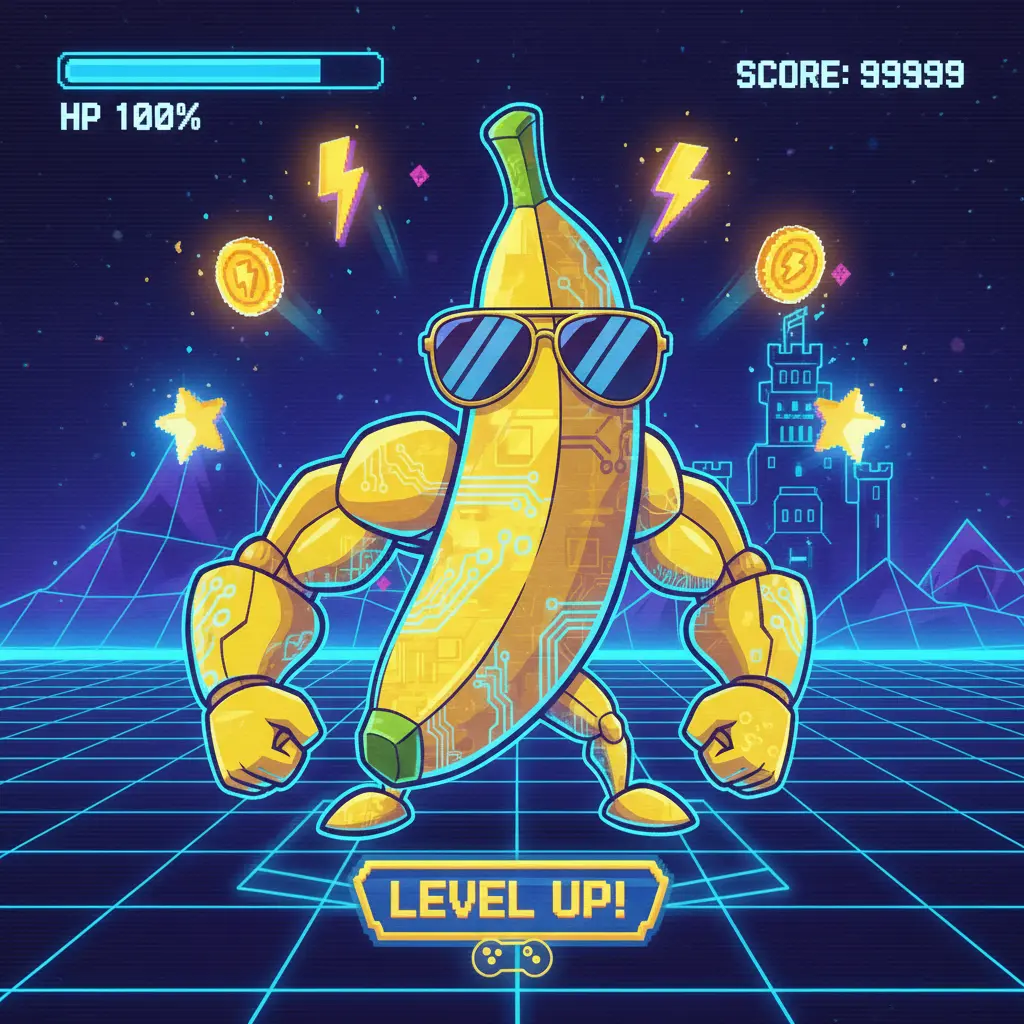
Nano Banana.
- Text to Image
- $0.04 por imagem
- ~5 seg média
Synthesize low-cost and resource-friendly images in seconds for mobile apps and rapid prototyping processes using the nano-banana model.
Em que Nano Banana se destaca.
 Ideal para
Onde se encaixa
For developers building AI image editor API for mobile apps, nano-banana processes text prompts plus reference images to generate prototypes rapidly—upload a…
 Limites e dicas
Como obter bons resultados
Access nano-banana seamlessly through Eachlabs' Playground for instant testing, API for production-scale nano-banana API calls, or SDK for custom integrations…
 Modelo relacionadoVer modelo
GPT Image | v2.6 | Sunburst | Text to Image
Execute-o com a mesma entrada para comparar resultado, velocidade e preço.
Documentação do modelo
Sobre este modelo
Synthesize low-cost and resource-friendly images in seconds for mobile apps and rapid prototyping processes using the nano-banana model.
Visão geral
nano-banana — Text-to-Image AI Model
Developed by Google as part of the nano-banana family, nano-banana is a text-to-image AI model powered by the Gemini 2.5 Flash Image architecture, designed for rapid, low-latency image generation ideal for mobile apps and prototyping workflows. This Google text-to-image solution excels in producing high-quality visuals in seconds, supporting resolutions up to 1K for efficient, resource-friendly outputs that prioritize speed without sacrificing detail. Users searching for a text-to-image AI model with conversational editing capabilities will find nano-banana's multimodal processing—handling text prompts alone or combined with images—enables unprecedented control for iterative design.
Capacidades
- Generates high-quality images from text prompts and uploaded photos
- Edits existing images with natural language instructions, including object replacement, style transfer, and scene modification
- Maintains character and style consistency across multiple images and edits
- Blends multiple images or styles into a single cohesive output
- Supports rapid, real-time creative workflows with most edits under 10 seconds
- Integrates invisible watermarking for authenticity and provenance
- Interprets complex scenes, diagrams, and sketches with context-aware understanding
- Enables iterative storytelling and scene refinement without loss of coherence
Casos de uso
Use Cases for nano-banana
For developers building AI image editor API for mobile apps, nano-banana processes text prompts plus reference images to generate prototypes rapidly—upload a UI sketch and prompt "add a nano banana dish in a Gemini-themed restaurant with elegant plating," yielding a polished 1K visual in seconds for quick testing.
Marketers creating e-commerce visuals use its text rendering to produce product mockups with accurate labels; input a photo and "place this shoe on a urban street at dusk with 'Limited Edition' text in bold script," streamlining campaigns without design software.
Designers prototyping infographics leverage multi-image synthesis, combining logos and charts via prompts for cohesive layouts; this supports iterative refinements conversationally, ideal for teams needing text-to-image AI model efficiency in branding workflows.
Content creators for social media generate themed assets grounded in real-time data, like "current weather map of Tokyo with cherry blossoms," using Google Search integration for timely, factual visuals that boost engagement.
Dicas e truques
How to Use nano-banana on Eachlabs
Access nano-banana seamlessly through Eachlabs' Playground for instant testing, API for production-scale nano-banana API calls, or SDK for custom integrations. Provide text prompts, optional reference images (up to 14), aspect ratios like 16:9, and resolution settings (1K optimized), receiving high-quality PNG images with embedded text and refined compositions in seconds.
---Especificações técnicas
What Sets nano-banana Apart
The nano-banana model stands out in the competitive landscape of text-to-image AI through its optimization for high-volume tasks, delivering images at 1K resolution (around 1024x1024 pixels) with aspect ratios like 16:9 and processing times under seconds. Unlike many models, it leverages a "thinking mode" that generates interim thought images to refine compositions, ensuring precise prompt adherence for complex scenes.
- Advanced multimodal input with up to 14 reference images: Combine text prompts with multiple images for synthesis; this allows precise style transfers and fusions, enabling developers to build sophisticated AI image generator API tools that maintain consistency across references.
- Legible text rendering in images: Produces clear, stylized text suitable for infographics and menus; marketers gain professional assets like posters without post-editing, a edge over models struggling with typography.
- Conversational iteration and Google Search grounding: Edit images via follow-up text or ground visuals in real-time data; creators achieve context-aware outputs like current event visuals, differentiating it for dynamic Google text-to-image applications.
Supporting formats include PNG outputs via Gemini API, with configs for 1K/2K/4K (nano-banana focuses on efficient 1K), making it a top choice for nano-banana API integrations.
Pontos de atenção
- Some experimental features, such as advanced style blending and multi-image storytelling, may behave unpredictably in edge cases
- Users report occasional quirks with object placement or background consistency, especially in highly complex scenes
- Performance benchmarks indicate superior speed and consistency compared to leading competitors, but resource requirements for high-res outputs may be significant
- Consistency across edits is a major positive theme in user reviews, with many praising the model’s ability to maintain character identity
- Common concerns include occasional generic outputs when prompts are not sufficiently detailed
- Positive feedback centers on speed, ease of use, and creative flexibility
- Negative feedback patterns include limitations in ultra-realistic rendering and occasional artifacts in blended images
Considerações principais
- Nano Banana excels at maintaining character and style consistency across multiple images, which is critical for storyboarding and branding
- Best results are achieved with clear, detailed prompts that specify desired styles, objects, and context
- Iterative refinement is encouraged; users can repeatedly edit and adjust images without losing coherence
- Quality and speed are balanced, but extremely complex scenes may require additional prompt tuning for optimal results
- Prompt engineering is key: specifying relationships, lighting, and mood yields more accurate outputs
- Avoid overly vague prompts, as the model may default to generic interpretations
- Watermarked outputs ensure authenticity but may affect workflows requiring unmarked images
Limitações
- Primary technical constraint is the lack of publicly disclosed parameter count and architectural details, limiting transparency for advanced users
- May not be optimal for ultra-realistic photorealism or highly specialized artistic styles outside its trained domains
- Complex multi-object scenes can sometimes result in minor inconsistencies or artifacts, requiring prompt refinement
Note: The model won't always follow the exact number of image outputs that the user explicitly asks for.
Perguntas sobre este modelo
As respostas curtas. Para qualquer coisa específica do seu cenário, fale com nossa equipe.
 Fale com um engenheiroPlaneje para o volume que você espera.
Nano Banana is Google's base-tier lightweight text-to-image model that generates images from natural language prompts with a focus on fast generation and cost efficiency. It is the foundational model in the Nano Banana family, designed for rapid iteration, prototyping, and high-volume applications where speed and affordability are more important than maximum fidelity.
Use Nano Banana base when generation speed and API cost per image are the primary constraints and the output is for internal use, prototyping, or non-critical applications. Upgrade to Nano Banana v2 for improved quality in the same lightweight family, or to Nano Banana Pro when commercial-grade visual fidelity is required for the final output.
Nano Banana is available on the eachlabs platform under the model ID nano-banana. Send a text prompt to the eachlabs unified API and receive a generated image. eachlabs provides access to all tiers of the Nano Banana family including base, Pro, and v2 variants on a single pay-as-you-go account with no Google Cloud setup required.